For those who have read our article ‘Thai Citizenship when born overseas’ you’ll understand the starting point of your journey is to apply for a Thai birth certificate from the Thai embassy in the country which you were born.
While in many cases this is a very straight forward process, there are certain parts of the application which need to be done entirely in Thai, which poses a challenge for many people who are doing the application by themselves. For those who don’t have a Thai parent or relative to assist, we now offer a service to help you fill in and complete your Thai birth certificate application.
A standard Thai Birth certificate
We’ve assisted clients across the world – and have dealt with the Thai embassies or major consulates in Australia, New Zealand, United Kingdom and the United States.
Our service also includes Thai language liaison with the embassy to help prevent miscommunications and misunderstandings.
So if you need assistance in obtaining your Thai birth certificate, please send us message!
Do you have a complex case?
The mission of this website is to provide factual and useful information on all things to do with Thai citizenship and permanent residency. We want to be the most authoritative place on the internet, stripping away both the misleading ‘bar stool gossip’ and lawyers hoarding information, stifling your ability to understand your options. If you can walk away from reading this website, able to undertake the PR or Citizenship process yourself without having to engage an overpriced and under-experienced lawyer, then our job is done.
Nevertheless, we realise that everyone’s case is unique. If you’ve read the website and would like a one-on-one consultation to discuss your personal case and circumstances, then please click on the link below where you can organise a time to speak.
If you are looking for help with your Thai citizenship or Permanent Residency application, you’ve come to the right place. Our mission is to provide factual and useful information on all things to do with Thai citizenship and Permanent Residency. We want to be the most authoritative place to help you on your Thai citizenship journey, stripping away both the misleading ‘bar stool gossip’ and lawyers hoarding information, stifling your ability to understand your options. If you’ve come to this website, you can see we are the most knowledgeable experts on this topic.
Nevertheless, we realise that everyone’s case is unique, and sometimes you need just more than advice to navigate the bureaucratic side of things. Depending on your situation, we offer a number of services.
The process for applying for Thai Permanent Residence is probably one of the most paperwork heavy and exacting for an applicant. In addition, it requires the applicant to be in regular contact with the PR desk over the space of many months prior to the actual application dates. For those who are familiar with our advice on how to apply, you’ll know that the applicant simply cannot be a bystander to the process and needs to be actively involved. Where many people fall over is in the document gathering and preparation stages, or they simply run out of time to collect the right documents and present them properly.
Documents needed for a typical PR submission (Photo credit: Rick Moore)
We have successfully helped many foreigners obtain Thai PR over the years and can use this experience to provide practical assistance and insight in bringing application together via a DISCREET and ETHICAL approach to help prepare your documentation, and to coach you through your application
2) Thai citizenship (via naturalization)
For those looking to apply for citizenship, based on holding PR or being married to a Thai citizen, in addition to helping you understand the process and the expectations, we can also assist you with your documentation gathering and application assistance in a discreet and ethical manner.
However, we’ve had a lot of experience in guiding people through the process and helping them deal with various agencies on the ground helping people attain their rightful entitlement to Thai citizenship.
What are the next steps?
The process starts with a paid consultation to understand your situation and for you to ask any questions you might have after studying our website. We will also offer an assessment on if you are indeed eligible. Simply click on the link below to book a time.
Following that call, if you are happy to continue on your own, then we’d consider our job done. However, if you choose to utilize our ‘on the ground’ assistance to help prepare your application, then the first consultation will be credited against the cost of any follow up work.
If you are working for yourself and are looking towards becoming a Thai Permanent Resident or a Thai Citizen, then establishing a company in Thailand to act as your local employer is crucial. Working for a Thai entity is one of the key criteria you need to apply for both Thai Permanent Residency and Thai Citizenship. Without officially being a Thai employee, you simply aren’t eligible. To find out why it is so important to be employed by your own company, this article below outlines what you need to know.
We’ve been approached by many people over the years who would like to obtain citizenship or permanent residency but simply don’t have the correct structures in place. So here at www.thaicitizenship.com we’ve come up with a solution which will help set you on your path to staying in Thailand forever. We have partnered with some excellent lawyers and accountants who work with you to establish your firm in Thailand legally and provide you with ongoing administrative services at highly competitive prices. Please feel free to drop us a line via our contact page to find out more.
If you are based in Thailand, working for yourself, and looking to one day get Thai PR or citizenship, but work remotely or derive your income from offshore, then having a Thai company is a must. The article below helps you understand why this is important.
Paths and dead ends to Thai citizenship
Staying for extended period of time in Thailand has never been easier. But setting up your stay so that you qualify for both PR and Citizenship requires a little more planning.
The proliferation of visas by the Thai government, has meant its now much simpler for people to come and live and work in Thailand for months and years at a time. Options such as the ‘Destination Thailand Visa’, commonly known and the DTV Visa, the Long-Term Resident Visa (also known as the LTR visa) and the various incarnations of the Thailand Elite Visa have opened the door to longer stays in Thailand for many looking to stay in Thailand. For those over 50 years of age, retirement visas are also an option, or marriage visas for those married to Thai citizens
But while these visas give you the right to stay in Thailand for an extended period of time, they ultimately are temporary in nature and offer no guarantees of renewal. To stay in Thailand without any limits on your stay, you either need Thai Permanent Residency, or Thai citizenship.
How do I get Thai PR or Citizenship working for myself?
One of key requirements for qualifying for either of these is for you to earn a sufficient income to qualify. For those wanting to get Thai Permanent Residency, the income needed is a minimum of 80,000 baht per month for three years, or 30,000 baht per month if you are married to a Thai citizen.
For those wanting to apply for Thai citizenship, the numbers are similar. A minimum of 80,000 baht per month for three years, which is lowered to 40,000 baht per month for those married to Thai citizens.
In many cases, people based in Thailand but working remotely have that income paid to them offshore. These people generally tend to be ‘digital nomads’, or in other cases, employees or contractors to foreign companies who live in Thailand but work elsewhere.
One of the major misconceptions is that we hear a lot is that from people looking to get Thai PR or citizenship is that they think that earnings from these offshore activities can be considered.
Unfortunately, for the purposes of residency or citizenship applications, offshore income doesn’t count. The income needs to be sourced from a Thai entity based on work that you’ve done for that entity. In other words, a Thai based salary.
As such, working for a Thai company in most cases is a crucial, and non-negotiable, part of most Thai citizenship or Permanent Residency applications. On top of that, the other ‘must haves’ are work permits, and Thai income tax returns based off that same Thai company.
For expatriates working here for a Thai firm already, that makes applying for PR or citizenship fairly straight forward.
However, for those who earn income offshore, you are going to need to channel your income into Thailand via a Thai corporate entity. In other words, you are going to need to be employed and paid by a Thai company.
Establishing your own Thai company vs using an ‘Employer of Record’
For those who earn income outside of Thailand and are needing a company structure and work permit to stay in Thailand, there is a huge temptation to make things easy and engage what is known as ‘Employer of Record’ (EORs).
EORs are essentially visa and work permit ‘shops’ who have established a corporate entity that makes you an instant employee on paper. These Thai EOR’s provide you with a ready-to-go work permit, act as your official employer and HR, paying your salary and social security contributions. For their services, the EOR will invoice you offshore for these services and typically charge a 20% to 30% premium on top of your ‘salary’ for you to remain an ‘employee’.
The downside of using EORs
One of the major downsides of using an EOR becomes apparent after you’ve been with them a few years and want to apply for citizenship or permanent residency in Thailand.
As part of the citizenship or permanent residency application process, you will need to show as part of your application a variety of company registration, tax and earnings documents. Normally, if you work as an ‘regular’ employee of a normal firm, these documents are mostly fairly straight forward to get.
However, EORs know that these documents are valuable, and generally make it impossible for their ‘employee’s’ to get them – unless they pay them a very large fee.
If you decide to go elsewhere and you lose your work permit, the three year qualification clock for PR and citizenship restarts. So your hands are tied. We’ve heard that many EOR firms will charge applicants wanting to access these documents anywhere up to 600,000 baht. The costs don’t just end there however, depending on the amount of employees the EOR has, statutory printing costs by the government agency responsible printing these can run into the tens, if not hundreds of thousands of baht.
At the other end of the spectrum, some EOR’s will simply just refuse to cooperate given that they will be forced to hand over sensitive corporate information as part of your citizenship or PR application.
Don’t risk using an EOR. Establish your own company instead
The only way to avoid all this is to establish your own Thai company. One which you can control.
The company you establish will be your formal employer, providing you with a work permit and thus formally qualify you apply for either Thai Permanent Residency or Thai Citizenship.
Your Thai registered company will invoice your offshore clients and you can channel those revenues properly and legally into Thailand. You can decide yourself the amount of monies you need to be diverted into Thailand, and use them as your living costs, as well as the same time, lining yourself up to be fully qualified to apply for citizenship or PR later down the track.
Do you still need assistance?
The mission of this website is to provide factual and useful information on all things to do with Thai citizenship and permanent residency. We want to be the most authoritative place on the internet, stripping away both the misleading ‘bar stool gossip’ and lawyers hoarding information, stifling your ability to understand your options. If you can walk away from reading this website, able to undertake the PR or Citizenship process yourself without having to engage an overpriced and under-experienced lawyer, then our job is done.
Nevertheless, we realise that everyone’s case is unique. If you’ve read the website and would like a one-on-one consultation to discuss your personal case and circumstances, then please click on the link below where you can organise a time to speak.
Helping you establish your own Thai Citizenship compliant company
Given that we’ve been approached by so many people over the years who would like to obtain citizenship or permanent residency, but simply don’t have the correct structures in place, here at www.thaicitizenship.com we’ve come up with a solution which will help set you on your path to staying in Thailand forever.
We have partnered with some excellent lawyers and accountants who work with you to establish your firm in Thailand legally and provide you with ongoing administrative services at highly competitive prices. Please feel free to drop us a line via our contact page to find out more.
Thai permanent residents are given a number of rights and privileges that aren’t available to normal visa holders in Thailand. The main one being is that Thai permanent residents have the unlimited right to live in Thailand forever. This is a huge benefit for many, and who can then avoid the annual visa extensions, and the burdensome requirements needed to maintain marriage or retirement visas in Thailand.
In addition, despite what the slick haired lawyers will tell you (and sell you) Long-Term Resident (LTR) permits, and Destination Thailand Visas (DTVs) are not a form of permanent residency at all given their stays eventually run out. Nor to any of these visas provide a path to proper Permanent Residency or Thai citizenship.
The Thai version of permanent residency shouldn’t be compared to those available in the west (eg. ‘Green Cards’ in the US or Indefinite Leave to Remain in the UK) where holders are given all rights to live and work and are given similar rights to citizens, except for voting and running for political office. The Thai version of Permanent Residency does not grant working rights and holders will still need to request work permits from the Department of Labour.
Given changes in Thai citizenship laws in 2008, those married to a Thai citizen can skip the need of even holding Thai permanent residency and apply direct for citizenship after working in Thailand for three years. However, for those who aren’t married to a Thai citizen, or who’s current nationality does not allow dual citizenship with Thailand, then Thai PR will be as far as you can go. As such it is important to understand the rights that Thai PR’s do hold.
Main benefits and rights of Thai permanent residents
The following list was printed by the Department of Provincial Administration, and the original Thai version can be found HERE(ผู้ถือใบถิ่นที่อยู่ถาวร ได้รับสิทธิอย่างไรบ้าง)for those who may have need for an official source for their own usage. However, I have reproduced it below in Thai and English.
มีสิทธิที่จะอยู่ในประเทศไทยเป็นการถาวร โดยไม่ต้องคอยยื่นคำขอเพื่อพำนักอยู่ต่อเป็นการชั่วคราวในแต่ละปีอีก: The right to reside permanently in Thailand, without needing to submit a petition to immigration to confirm that they will continue to reside for the following year.
มีสิทธิได้รับใบสำคัญประจำตัวคนต่างด้าว ซึ่งเปรียบเสมือนเป็นบัตรประจำตัวประชาชนสำหรับคนต่างด้าว: The right to receive an alien identification card, which is similar the Thai national identification card, but for non-Thai’s.
มีสิทธิที่จะได้รับการบันทึกชื่อเข้าอยู่ในทะเบียนบ้าน (แบบ ท.ร.14) เช่นเดียวกับคนสัญชาติไทยด้วย: The right to have their name recorded in the house registration (Form Tor. Ror. 14) along with other Thai nationals
มีสิทธิตามที่กฎหมายต่างๆ ได้กำหนดไว้ เช่น ได้สิทธิเกี่ยวกับสัญชาติของบุตรที่เกิดในประเทศไทยเพราะในกรณีที่บิดาและมารดาเป็นผู้มีถิ่นที่อยู่ในราชอาณาจักร เมื่อมีบุตรเกิดในประเทศไทย บุตรก็จะได้สัญชาติไทย (มาตรา 4 แห่งพระราชบัญญัติสัญชาติ (ฉบับที่ 2) พ.ศ. 2535): Other rights under various laws. For instance, children born in Thailand when both the father and the mother have permanent residency will acquire Thai nationality at birth- according to Section 4 of the Nationality Act (Second version) B.E. 2535
มีสิทธิซื้อห้องชุดในอาคารชุดที่เรียกกันเป็นภาษาอังกฤษว่า คอนโดมิเนียมโดยไม่ต้องโอนเงินจากต่างประเทศเข้ามาซื้อ เพราะถ้าหากไม่ใช่เป็นคนมีถิ่นที่อยู่ในราชอาณาจักร จะต้องโอนเงินจากต่างประเทศ เข้ามา จึงจะมีสิทธิซื้อได้ (มาตรา 19 แห่งพระราชบัญญัติอาคารชุด (ฉบับที่ 2) พ.ศ. 2534): The right to purchase a condominium in a building, without needing to transfer funds to purchase the condo from abroad, which is something required for all other foreign nationals in Thailand (Section 19, Condominium (No. 2) B.E. 2534)
สามารถขอเอกสารใช้แทนหนังสือเดินทางของประเทศไทยเพื่อใช้สำหรับเดินทางไปต่างประเทศ ได้ด้วย เพราะบางในกรณีคนต่างด้าวผู้ที่มีถิ่นที่อยู่อาจจะขอหนังสือเดินทางจากสถานทูตหรือสถานกงสุลที่ ตนมีสัญชาติ ไม่ได้ด้วยเหตุผลบางประการ ดังนั้น เมื่อมีความจำเป็นจะต้องเดินทางไปต่างประเทศ จึงจำเป็น ต้องไปขอเอกสารใช้แทนหนังสือเดินทางจากกระทรวงการต่างประเทศของไทยเพื่อสำหรับใช้เดินทางแทนหนังสือเดินทาง: The ability to request for travel documents for international travel in the case where the embassy or consulate of your citizenship is unable to do so. The documents are available from Ministry of Foreign Affairs of Thailand.
Do you still need assistance?
The mission of this website is to provide factual and useful information on all things to do with Thai citizenship and permanent residency. We want to be the most authoritative place on the internet, stripping away both the misleading ‘bar stool gossip’ and lawyers hoarding information, stifling your ability to understand your options. If you can walk away from reading this website, able to undertake the PR or Citizenship process yourself without having to engage an overpriced and under-experienced lawyer, then our job is done.
Nevertheless, we realise that everyone’s case is unique. If you’ve read the website and would like a one-on-one consultation to discuss your personal case and circumstances, then please click on the link below where you can organise a time to speak.
Thai adoptees, people who were born in Thailand and then adopted abroad form a small, but important, portion of people looking to reclaim their Thai citizenship.
According to one source, there were around 1,000 international adoptions from Thailand between 1999 and 2015. Since 2015 it appears there were, on average, about 200 international adoptions per year from Thailand to the rest of the world.
As an adoptee, am I still a Thai citizen?
Put simply: YES!
From Thailand’s perspective, the fact you were adopted by foreign parents and raised abroad DOES NOT extinguish your Thai nationality. Thailand has no problems with dual citizenship for those who were born as Thai citizens. As such, all Thai adoptees abroad are still Thai citizens, but ones who at this point is without any up-to-date documentation.
Additionally, it does not matter whether there were official Thai citizen parents registered on your Thai birth certificate, or whether, as an orphan, the identity of your parents is unknown. In both cases, Thailand nationality law recognizes you officially as a Thai citizen.
If you are in this group, the process to reclaim your Thai documentation is pretty straight forward, though requires you to deal with a number of agencies along the way.
Thai citizenship basics
All Thai citizens are registered on what is called a house registration, or Tabien Baan (ทะเบียนบ้าน). All Thai’s are placed on one at birth. This is normally a family home address, but in the case of most adoptees, it will be on the tabien baan of their children’s home. All Thai citizens are given a 13-digit identification number at birth too. This follows them through life and appears on their Thai national ID card, which all Thai’s receive when they are 7 years old. It is essential for any citizen to have a valid ID card to undertake any government related transactions, including getting a Thai passport. So the first order of business for any international adoptee looking to revive their Thai citizenship is to get a new Thai ID card.
As a primer, I recommend anyone reading to have a look at “Reclaiming Thai Citizenship” which is designed for anyone born in Thailand looking to re-establish their Thai identification papers. For the most part, this article is aimed at Thai’s who have voluntarily moved abroad. However, reading it will help Thai adoptees understand how this process will ultimately work, and the steps needed to end up with a Thai ID card and Thai passport (with a little help from the related adoption agencies).
For a Thai adoptee who has lived abroad, the process is exactly the same as outlined in the “Reclaiming Thai Citizenship” article, but with one additional first step (which varies depending on your circumstances).
Contacting the children’s home
The best starting point is to contact the orphanage which dealt with your adoption. From our experience orphanages are meticulous record keepers and will have access to all your records from your time in Thailand. Most of them also have significant experience in helping people reclaim their Thai documentation.
They will also – 99% of the time – be the location of your house registration in Thailand, and having a house registration is essential before any Thai ID cards and passports can be issued. As such, in cases we have seen, staff from the orphanage will be able to accompany you to the district office and confirm your identity, to help you get your ID card re-issued, and cement your Thai citizenship documentation, making the process quite seamless.
What if I don’t know my children’s home?
Another couple of paths exist to kick off the retrieval of your Thai ID.
In some cases, your adoption agency will also have records of your original ID. Some like Holt International, will be your first point of call.
In other cases, for example when the children’s home has been closed, or the adoption agency no longer operates in Thailand, the Child Adoption Centre (which is part of the Department of Children and Youth at the Ministry of Social Development and Human Security) will be your first port of call. The Child Adoption Centre, being an official government department, will normally have all historical files of (legal) adoptions out of Thailand
The first step is to email them. However please take care to have ensure that you have collected as many relevant documents as you can from your parents relating to your adoption. When you email them, they will normally ask for details from records in your possession so they can cross match these details with their records. These normally include as many of these you can provide:
Thai Adoption Registration
Adoptive parents’ passport
The child’ passport
The child’ birth certificate
The child’s photo with (1×1 inch)
If they think they can assist, they will ask you to come to Thailand to meet them at a pre-arranged time. Wherever possible, the Child Adoption Center will cooperate with a Babies’ Home where the child used to be, but if not, they will normally assist you themselves in working to get fresh up to date copies of your Thai document from the district office, including your Thai ID card, which will officially state you are a Thai citizen.
FAQ’s
Question: Can I do my first Thai ID card overseas, at the Thai embassy in the country I live in?
It is important to understand that this process outlined above can’t be done overseas, via an embassy or consulate. While Thai ID cards can be renewed via an embassy or consulate abroad, the very first Thai ID must be issued in Thailand, so you must travel here for that. Once the Thai ID has been issued, it is a very easy matter for applying for a Thai passport (which can be done both in Thailand or abroad).
Question: I’ve since taken on the nationality the country where I grew up. Does Thailand allow for dual citizenship?
Thailand has a fairly relaxed attitude to dual citizenship, so it’s not an issue. And for those who are natural born Thai’s (of which all adoptees will be) the Thai constitution forbids the involuntary stripping of citizenship. For the ins and outs of this topic, please read our article “Thai citizenship, is it legal?“
Question: Do I have to worry about Thai Military service?
There is no simple answer to this. While it is required that all Thai males are required to do military service, those living overseas at the time of conscription (normally age 21) and without complete Thai documention (for example ID cards) aren’t in the system to be ‘called up’. Add to this, at age 30 all males automatically are exempted from military service. In the main, so long as you don’t come back to live in Thailand full time before your 30, it is unlikely you’ll need to worry about this issue. For an indepth look at the topic, please click on “Thai military service for dual citizens“
Do you still need assistance?
The mission of this website is to provide factual and useful information on all things to do with Thai citizenship and permanent residency. We want to be the most authoritative place on the internet, stripping away both the misleading ‘bar stool gossip’ and lawyers hoarding information, stifling your ability to understand your options. If you can walk away from reading this website, able to undertake the PR or Citizenship process yourself without having to engage overpriced and under-experienced lawyers, then our job is done.
Nevertheless, we realise that everyone’s case is unique. If you have embarked on this journey yourself, and are finding you are hitting brick walls within the Thai bureaucracy, or are currently overseas and would like to get a few things in place before you travel to Thailand, then we can help. We have, and continue to help Thai adoptees from abroad reclaim their birthright.
For a one-on-one consultation to discuss your personal case and circumstances, please click on the link below, where you can organise a time to speak.
There are a number of really useful tips and tricks that can help save you time and effort when putting together your Thai Permanent Residency Application (ถิ่นที่อยู่ถาวร). While many think that the biggest headache is dealing with the PR folks at immigration, they soon discover that it’s actually dealing gathering the documents that are needed for your application.
There are two categories which we focus on in this article:
Company and employment related documents
Educational and criminal records from your home country – and actually getting them authenticated and certified properly in accordance with Thai government processes
Both of these items are the biggest headaches in the PR process but this article offers some valuable tips and tricks that might save you from some unnecessary gray hairs!
Company and employment related documents
The criteria set out by immigration lists a range of documents needed for any PR application. (For simplicity, I am using the list of documents needed for people applying under the working/business category which can be downloaded from HERE).
Your own Finance and HR departments will have a substantive portion of the documents needed related to your employment and the company you work for in Thailand.
Our main advice for anyone applying for Thai Permanent Residency is to become best friends with your Human Resources department and have them on board for when you decide to apply. If you can get all of the required documents through them, then well and good.
However it isn’t unknown – actually quite common – for your HR department to drag its feet to the detriment of your Thai Permanent Residency application. So, it’s worthwhile knowing that if you want to ‘lighten their load’ so to speak, then you can organize to have most, but not all, of the documents collected yourself.
Thailand actually has a pretty good public database where statutory company documents are stored online and can be accessed by the general public. The organisation responsible for this is the Department of Business Development (กรมพัฒนาธุรกิจการค้า) or DBD.
Tip 1: The ‘easy to get’ documents
While the DBD has all documents online, the PR desk will need those documents certified by both the DBD and then the Revenue Department, so it’s worth actually going to a DBD office to get the printouts and certifications from them before heading over to the Revenue Department.
Some documents pertaining to your employer such as Company Registration, Balance Sheet/Profit and Loss Statement and List of Shareholders can be obtained by anyone who goes to the DBD, so there is no need to involve the employer with these if you don’t want to.
Other documents such as those outlined in Item 12 of the PR document checklist including the “Copy of the value added tax (VAT) or the specific business tax registration”: The Phor Phor 01, Phor Phor 09, and Phor Phor 20 (ภพ01, ภพ09, ภพ20 respectively) are normally readily available to your company’s finance department, so it shouldn’t be an effort for them to pull those documents up and print them out for you.
Please note too that it is likely that the PR desk will want these documents signed by the company’s directors and stamped with the company seal.
Tip 2: The ‘difficult to get documents’
Major problems come from trying to access ภงด01 (Por Ngor Dor 01 – A copy of the list of withholding income tax of Thai employees 1) and ภงด50 (Phor Ngor Dor 50 – company income tax form) due to their confidentiality.
These documents can be highly guarded as they contain sensitive employee and company data. While the company will be very used to submitting them to the tax department, Finance and HR departments will often balk at sharing these with anyone else
Tip 3: A work around for the PND 01 and PND 50 forms…
If the company is uncomfortable with you having access to these documents, then we can suggest certain workarounds to preserve confidentiality for these two sensitive documents.
An authorized person in the company could give you the documents in a sealed envelope for you to hand over the documents to the PR desk.
If that doesn’t work, an alternative could be that someone external to the company (like your company’s auditors) is given the authorization by your directors to request these documents from the revenue department provided that they sign a non-disclosure agreement with your employer. This is likely going to happen at your own expense, but in some cases, it is the only way.
Please note that if you work for a particularly large firm, these can be costly – depending on the number of employees in your company as you need to pay for the document to the revenue department.
Authentication of documents from your home country
For your Thai permanent residency application, you’ll also be needing to provide the following:
Educational certificates of your highest degree or educational attainment (including vocational training).
Police clearances/Criminal background checks from the country of your current nationality that has been issued in the three months leading up to your PR application.
Before you can submit these documents, they’ll need to be fully legalised (sometimes called an ‘apostille’) by the nominated state or national authority (sometimes both), before being sent to the Thai embassy in the country where these were issued. The embassy will then ‘legalise’ these documents before they can be sent onto Thailand. Before they are submitted to the Thai PR team, these documents need to be translated to Thai and the further certified by the Thai MFA.
These steps are time consuming and but essential to ensure that your documents are recognized in Thailand. For the educational documents, it is well worth doing them well ahead of any potential PR application as for most countries they can take some weeks.
Unfortunately, it doesn’t make sense to outline these in detail here as every country follows a different procedure on how you authenticate a document. However the Thai embassy in each country should have online details on how this process works and under the ‘Consular Services’ page you see the country specific information under the ‘legalization’ tab.
For all applicants from the Republic of Ireland, N.I., and the UK click this link
Other Thai PR tips and tricks
This webpage as received many, many tips and tricks from readers who’ve gone through the process. Here are some things to look out for (in no particular order):
Criminal Background Checks for US citizens: Please note that given that these FBI checks must be no older than 3 months on the date of submission of your PR application, time is really of the essence to get them done. In the US the FBI generated report needs to be done with both State and Federal Level authentications, before being sent to the Thai embassy. At present the US Department of State has about an 11-week average processing time in addition to the Thai embassy 3 weeks if all this is handled by mail. So for this step we recommend hiring external counsel in the US to handle these processes as much as possible physically so as to avoid unnecessary delay.
For documents legalized out of the United Kingdom: We’ve had a lot of PR applicants tell us a company called ‘Apostille of The Hague’ to be well versed in dealing with the issue from a Thai perspective (please note we do not have a commercial relationship with them nor formally endorse them and we suggest all readers do their own research before engaging them).
Still need assistance with your PR application?
The whole purpose of this website is to provide factual and useful information on all things to do with Thai citizenship and Permanent Residency. We want to be the most authoritative place on the internet, stripping away both the misleading ‘bar stool gossip’ and lawyers hoarding information, stifling your ability to understand your options.
For those who want to do the Thai PR application themselves, we think that our website provides the most comprehensive level of information for you to begin your PR journey. If you can walk away from reading this website, able to undertake the PR or Citizenship process yourself without having to engage an overpriced and under-experienced lawyer, then our job is done.
Thai PR application service
Nevertheless, we realise that everyone’s case is unique and that people aren’t always in the position to do the paperwork themselves. For those in that situation, we’ve put together a service to help those who need assistance putting together their PR paperwork. Our advisors will work with you in the background to bring together your paperwork for your application. Our advisors have had great success in helping people achieve their dream of getting Thai Permanent Residency.
Please click on the link below to organize an initial consultation. If you decide to proceed with engaging our PR assistance service, the cost of the consult will be deducted from the overall fee.
The situation of Thai citizens entering Thailand on a foreign passport has led to a lot of confusion amongst both travellers and immigration officials. Questions arise as to how long that traveller can stay in Thailand legally, and whether if they got charged with overstay penalties if they stayed for more than the visa time limit set out in their non-Thai passport.
Travelling as a Thai dual citizen, the general rule of thumb has been that whenever entering Thailand, you enter Thailand on your Thai passport so not to be treated as a ‘foreigner’ for immigration purposes. (See our article on ‘Travelling as a Dual Citizen‘). From time to time however, Thai dual citizens find themselves needing to enter Thailand on their foreign passport. This can be for a variety of reasons including:
Having lost your Thai passport overseas and are unable to get a replacement from a consulate or an embassy.
Being an Overseas born Thai who has come to Thailand to finalise their citizenship documents including Thai house registration and Thai ID card.
Whatever the reason, sometimes Thai citizens find themselves entering Thailand on a foreign passport.
What used to happen?
In the past, if you were a Thai citizen entering Thailand on a foreign passport, you would be treated as a foreigner for immigration purposes. And even if you held a Thai ID card, and then renewed your Thai passport in-country, you were subject to the time limits that were stamped in your foreign passport.
For many, that wasn’t an issue, but it was an inconvenience. It meant that one had to fly out of Thailand on their foreign passport before their visa expired, or risk having to pay an overstay fine of 20,000 baht. While there are special visa’s for Thai citizens to stay on their foreign passports, including what we call the ‘Ancestry Visa’, it still meant you had to submit yourself to immigration to be in Thailand legally.
Penalties and restrictions scrapped for Thai citizens entering Thailand on a foreign passport
Since August 2023 however, common sense has prevailed, bringing to an end the perverse situation of many Thais (who, for a variety of reasons) enter Thailand on a foreign passport and are treated as a foreigner for immigration purposes.
The immigration department has sent a directive to all immigration officials stating that Thai nationals who enter Thailand on a foreign passport are no longer treated as foreigners so long as they also have proof of Thai nationality.
In the event they are departing at a date that is beyond the one stated in their ‘arrival’ stamp, they only need to show a valid form of Thai ID and they will allowed to depart without penalty. The immigration officer will simply note the travellers Thai ID number next to the departure stamp.
At the moment, it appears that immigration is insisting that this ‘proof’ be an valid Thai ID card, so we suggest you come prepared with one.
Natural born Thai’s (ie those born to at least one Thai parent anywhere in the world)
Those who have naturalized as Thai citizens, or who were born in Thailand to two foreign parents with Thai Permanent Residency.
For natural born Thai’s, the Thai Constitution makes it illegal to strip natural born Thai citizens of their citizenship. As such, entering Thailand on a foreign passport is fine.
But for the second group, for the moment, the safe answer is a hard ‘no’.
The Thai Nationality Act makes it very clear that naturalized Thai citizens or those who were born to two Thai permanent residents can be stripped of their citizenship if they ‘make use’ of their non-Thai citizenship in Thailand.
As such, for these people, only using your Thai passport to enter Thailand will be essential. We discuss that issue here in our article ‘Thai Dual Citizenship, is it legal?”
In the case that a Thai citizen has entered Thailand on a foreign passport and has overstayed on that passport, all you need to do is present your foreign passport as well as your Thai ID card.
It is essential that names in the passport and on the ID card are the same, as otherwise the immigration officer will be forced to charge you for overstaying.
Whatever the case, if you are unsure, we’ve included a copy of the memo to all immigration available for download at this link HERE.
Whatever the case, you’ll be stamped out of Thailand without issue, and assuming you’ve got a new Thai passport, you can re-enter the country on that at a future date.
The mission of this website is to provide factual and useful information on all things to do with Thai citizenship and Permanent Residency. We want to be the most authoritative place on the internet, stripping away both the misleading ‘bar stool gossip’ and lawyers hoarding information, stifling your ability to understand your options. If you can walk away from reading this website, able to undertake the PR or Citizenship process yourself without having to engage an overpriced and under-experienced lawyer, then our job is done.
Nevertheless, we realise that everyone’s case is unique. If you’ve read the website and would like a one-on-one consultation to discuss your personal case and circumstances, then please click on the link below where you can organise a time to speak.
Reclaiming Thai citizenship has become an increasingly popular and realistic goal for the estimated three million people of Thai ancestry living outside of Thailand.
Los Angeles has the largest Thai population outside of Asia
A large proportion of these were born in Thailand but migrated away many years ago as children or young adults. Some went with their families. Some went for study and never returned, while others, where adopted out from Thai orphanages to (mainly) parents in western countries. These people went on to naturalise and become citizens of their new country and established their life there. Increasingly, many of these people are keen to explore their roots, and even, in some cases, look to move back to Thailand, but are frustrated by the lack of information about how they can do so.
Who needs to read this article?
This article explores the options and methods available for those who were born in Thailand, but then moved away, and who are looking at renewing their Thai identity documents which will allow you to live and work in Thailand without restriction.
There are a number of different ways of reclaiming your Thai citizenship, depending on your circumstances of how you left Thailand, and the number of existing Thai documents you have. This article will be based on the assumption that you have at least one or more of the following:
A Thai birth certificate
A copy of your old house registration
An old Thai ID card
An old Thai passport
Thai relatives with valid Thai ID
Am I still a Thai citizen?
Many people write to this website asking how to ‘get back their Thai citizenship’, thinking they have lost it somehow. Others write saying they ‘gave up’ or ‘lost’ their Thai citizenship when they became a citizen of their new country (Thailand, for the most part, has no issue with people holding dual citizenship).
Based on the current Thai Nationality Act, anyone who is born on Thai soil to at least one Thai parent is a Thai citizen and REMAINS so, unless they give formally it up.
Furthermore, Section 39 of the Thai Constitution stipulates, “Revocation of Thai nationality from anyone who is Thai from birth shall be prohibited.”
What does it mean to formally give it up? It means that you’ve put in an application to the Thai Ministry of Interior, the Minister of Interior has signed off on the application, and the revocation has been formally been published in the Thai Royal Gazette (ราชกิจจานุเบกษา).
So, unless you formally have up given up Thai citizenship by this process, then quite simply – you are still a Thai citizen. You just are a Thai citizen who needs to re-establish your paperwork.
Reclaiming your Thai citizenship
Strictly speaking, you aren’t reclaiming your Thai citizenship. But what you are really doing is looking for the authorities to re-issue you with Thai Identification which all Thai citizens are entitled (and indeed must) hold. The main steps are outlined below
1) Don’t start with the Thai embassy (well mostly)
Most people will initially look to contacting the Thai embassy in the country they live in, ideally to get a new passport, only to find that the embassy isn’t being very helpful at all in helping you regain your Thai paperwork.
And the main reason is that the embassy really can’t help you get a new passport given how the Thai registration system works.
To get a new passport requires having a valid Thai ID card showing your 13-digit Thai ID number. To get a Thai ID card you need to be on the Thai house registration. All Thai people born in Thailand are normally registered on a house registration within 15 days of being born as a matter of course.
Though Thai embassies do issue new Thai ID cards for Thai citizens living overseas, you MUST get your first Thai ID card in Thailand. So, if you’ve left Thailand as a child, before getting your first Thai ID card, then the Thai embassy in the country where you live won’t be able to assist.
If you’ve got an old post 1984 ID card (with a valid 13 digit Thai ID number written in it), they may be able to issue you with a new one, on a case by case basis, or at the very least, the embassy MAY be able to provide you with an Thai emergency travel document, good for one entry back into Thailand. But don’t count on it.
2) You’ll need to travel back to Thailand
Thai district offices (สำนักงานเขต) are basically like mini-Town Halls (or City Halls for our US readers) where much of the administration of a particular district happens. They will also have an office which process peoples ID cards (บัตรประจำตัวประชาชน) and house registrations (ทะเบียนบ้าน).
If you don’t have many documents, the ideal first stop is the district office for the municipality where you were born. They will most likely have physical records of your original birth certificate and other details as to which house registration may be currently located.
3) Finding your Thai ID number
A standard Thai Birth certificate
Your Thai ID number is the key to getting your Thai documentation re-issued.
If you have it, your Thai birth certificate will list the district office where your birth was registered at, right at the top. If you have an old passport or copy of a house registration, your ID number will be listed in their too under ‘เลขประจำตัวประชาชน’
For anyone born post-1984, the Thai ID number will follow the modern Thai ID 13 digit numbering system which will be current and stay with you for life.
The ID number will be particularly important to track down your records.
What if I was born before 1984?
Fear not! Plenty of people born pre-1984 have successfully reclaimed their Thai documents.
Old paper house registrations being digitalisedDistrict office archives of old birth certificates
However the route is probably slightly more cumbersome given you will be dealing with an era of paper records and old form ID numbers, and the officers at the district office will likely need to go through the archives to cross match information. A huge process of digitization of old records has been ongoing in the past few years, so ideally an officer will be able to find your records on the system, scanned. But if that’s not yet the case, they will have to physically dig through old archive records.
4) Dealing with the district office
At the end of your time at the district office you will want to walk out with two things:
A copy of your house registration
A new Thai ID card
This will all take a few visits, but this is normal. Below we discuss how your visit to the district office will play out.
Understanding the district office’s mindset
Before we go any further, it’s important to understand the following as it will help you be patient with the process.
The district office will view your application to renew your Thai identity documents as a partial investigation. They’ll want firm evidence to proceed to show that the person standing at the district office (i.e. you!) and the one listed in the old documents are the same people.
The officer who you’ll deal with will only be able to re-issue you with Thai documentation if the weight of evidence is overwhelming that you are the person you claim to be. Unfortunately, unscrupulous and corrupt district officers have essentially been selling identities to foreign nationals looking to remain in Thailand. As a result of the crackdown against this, district officers will probably be highly cautious.
Your house registration
All Thai citizens born in Thailand are listed on a house registration within 15 days of birth. Normally this is at a family related residence. For those who have been out of Thailand for a while, there are normally two scenarios as to where your name is currently registered.
You remain registered on the house registration that you were originally on.
Your name has been shifted off that house registration to the Central House Registry (ทะเบียนบ้านกลาง) which if for those Thai citizens who have no registered address in Thailand. If you find your name has been moved there, you need to have your house registration moved back to a regular house register.
All Thai citizens are listed in house registration (tabieen baan) booklets like this one
So long as you have a valid Thai ID number, ANY district office in Thailand will be able to cross reference your records with their digital records on the national database, using your Thai name and unique Thai ID number which was allocated at birth, and tell you where you are currently registered.
Assuming you are on an existing house register (and the owner of the house register is happy for you to remain on it) then you need to proceed to get an ID card. The best place to do this if you’ve been away for a while is at the district office where you are currently registered.
If you find out that you are currently on the Central House registry, then you need to have your name moved off that (the district office will know how) onto a regular house register. You will need the permission of the head of the house register for that address to allow your name to be put on.
What (and who) to bring
This is all ultimately at the discretion of the district office you deal with, but here is a good list to start with (if you can!). Original is preferable, but copies can be useful:
Bring ANY and ALL Thai documents that you have.
Also bring ANY and ALL current foreign documentation (eg foreign passports) showing your name and dates of birth etc.
Bring ANY and ALL documents belonging to your parents (especially your Thai citizen parents), as that will be useful for officer to further cross reference information.
If your current name is not the same as your Thai name, bring any evidence which links you to your name change. This is crucial, as the district officer will won’t be able to assist you if the names don’t EXACTLY align (in the case of adoptees, this may simply be your adoption papers, court proceedings listing your adoptive parents surnames and your ‘new’ name).
It is also helpful, wherever possible, to bring with you your Thai parents, or other Thai speaking relatives or close friends. While this may seem quaint to foreigners, part of the process is to have at least two Thai national witnesses to ‘vouch’ for your identity and is totally a standard procedure.
Even when the evidence is overwhelmingly clear, the district officer will likely need approvals from senior people in the office to approve the re-issuing with Thai card. This will likely take some time, slow things down and in some cases, drag the matter out for weeks, if not months. This is more likely the case in rural areas, but just be aware it may happen.
The district officer will take all of the evidence provided and may ask for more – requests like certified translations of your foreign documents are pretty common additional requests. So long as the documents line up and the officer is satisfied, then your Thai ID card can be re-issued and from that you can apply for a Thai passport.
If the documents don’t match up, or what you provide isn’t sufficient for the district office, or you simply don’t have any, then there is one final option: a DNA test to prove your right to Thai nationality.
Given that Thai citizenship is passed down by blood, then a DNA test to an existing Thai relative will be sufficient get your Thai ID sorted. We write about that process in this article “Thai citizenship using DNA Testing”. For those who have struggled to get their paperwork to a level needed for the district office to be satisfied, the DNA test is the clear way to go.
People born in Thailand and then adopted abroad also form a large portion of people looking to reclaim their Thai nationality.
From Thailand’s perspective, the fact you were adopted and raised abroad DOES NOT extinguish your Thai nationality. If you are in this group, the process to reclaim your Thai documentation is exactly the same, but with one added step at the start. We’ve got a specific article for you titled “Citizenship for Thai Adoptees sent abroad” and it contains specific information to help you start down your path to Thai citizenship.
The mission of this website is to provide factual and useful information on all things to do with Thai citizenship and permanent residency. We want to be the most authoritative place on the internet, stripping away both the misleading ‘bar stool gossip’ and lawyers hoarding information, stifling your ability to understand your options. If you can walk away from reading this website, able to undertake the PR or Citizenship process yourself without having to engage an overpriced and under-experienced lawyer, then our job is done.
Nevertheless, we realise that everyone’s case is unique. If you’ve read the website and would like a one-on-one consultation to discuss your personal case and circumstances, then please click on the link below where you can organise a time to speak.
Healthcare costs are one of the key considerations for foreigners coming to live and work in Thailand.
The question often asked is how can one minimize these costs associated with health care? While private health insurance is available, premiums do get more expensive as you age, and for some insurers, once the customer reaches 65 or 70 years of age, you are either not offered any further insurance, or the list of exclusions makes it hardly worth it, even with prohibitive premiums.
Availing yourself to the comprehensive Thai social security hospital insurance scheme for $15 per month is an option for many who work in Thailand, so long as you sign up for it within six months of leaving your job. Doing so gives you lifetime universal health care funded by the Thai social security system and is probably one of the best health insurance deals around.
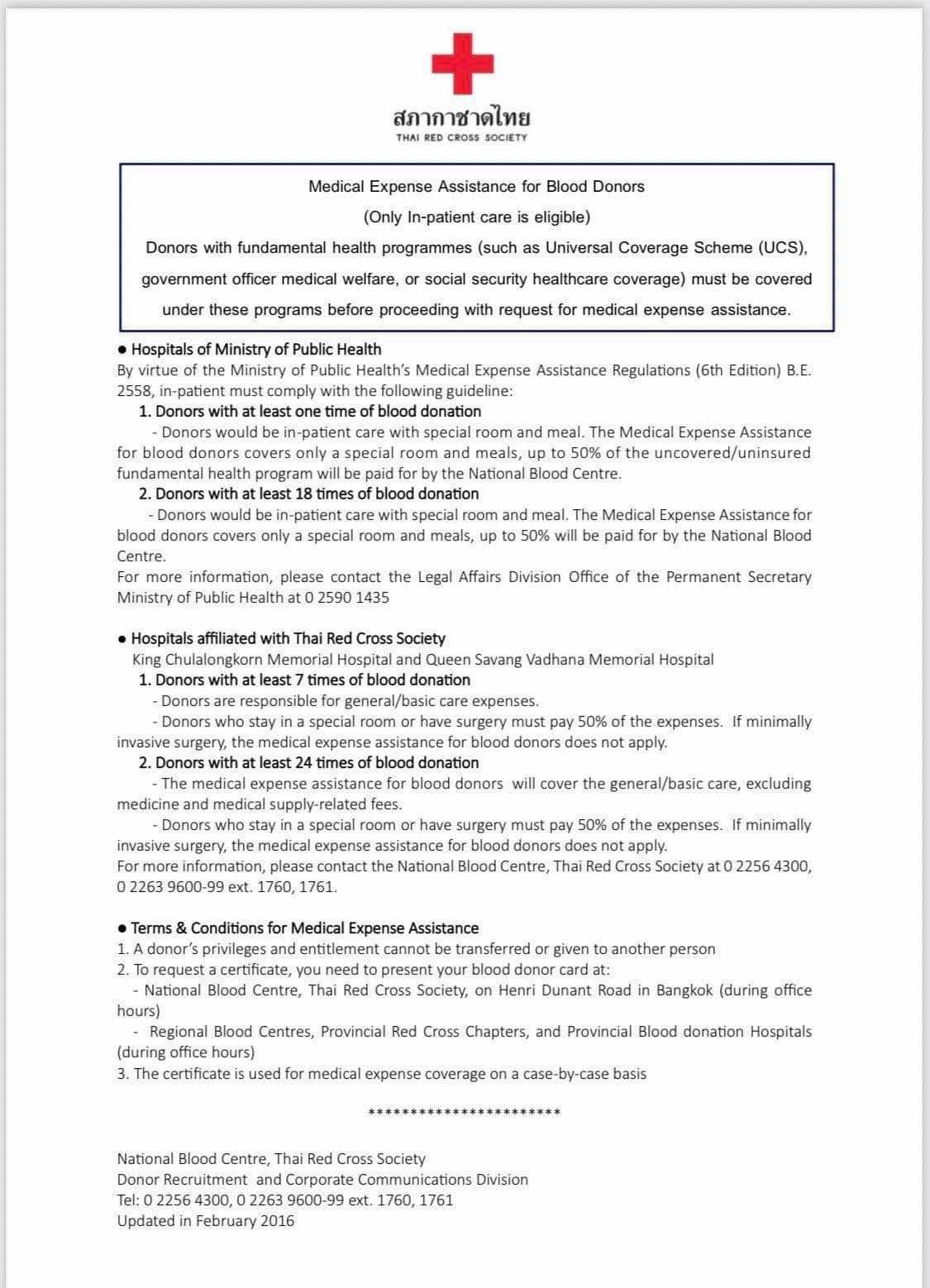
One additional option allows access to discounted health care which is also available to Thai’s and expats alike is subsidised in-patient health care via Thailand’s Red Cross. There is one condition, you have to be a regular blood donor!
However, if you’ve donated blood to the Thai Red Cross, Thailand’s two Red Cross affiliated hospitals (The very well regarded Chulalongkorn Hospital in downtown Bangkok and Queen Savang Vadhana Memorial Hospital in Sri Racha) will offer discounts on a number of services, depending on the amount of times you’ve donated.
Discounts on healthcare charges
At the two main Red Cross hospitals in Thailand, the following health care discounts will be offered, based on your donation history.
Donated 7 times: Entitlements to 50% off birth and regular surgical costs.
Donated 24 times: Ordinary medical expenses are free at Red Cross hospitals in Thailand.
At Thai Ministry of Public Health hospitals (public hospitals), donors with more than 18 donations will get 50% off room and special food fees. Even one donation will entitle you to a room discount and on some food according to scheduled fees. Note however, these benefits kick in after your other government provided benefits are exhausted (eg. Social Security health coverage).
Note: You must have made these donations before the age of 60, however the benefits are for life. To access take your donor card with you to the hospital and your charges will be adjusted accordingly.
Is this available to non-Thai Citizens?
Yes, it is. You just need to be a registered blood donor in Thailand. In case you think all this is it is too good to be true, here the links to official letters in Thai and English from the Thai Red Cross-National Blood Centre on the matter.
The mission of this website is to provide factual and useful information on all things to do with Thai citizenship and permanent residency. We want to be the most authoritative place on the internet, stripping away both the misleading ‘bar stool gossip’ and lawyers hoarding information, stifling your ability to understand your options. If you can walk away from reading this website, able to undertake the PR or Citizenship process yourself without having to engage an overpriced and under-experienced lawyer, then our job is done.
Nevertheless, we realise that everyone’s case is unique. If you’ve read the website and would like a one-on-one consultation to discuss your personal case and circumstances, then please click on the link below, where you can organise a time to speak.
error: Unfortunately, due to unscrupulous scammers who try and copy this content and pass it off as their own, this is protected and not available for cut and paste.
Did you get the info you need?
We realise that everyone’s case is unique. If you still have questions, or are hitting brick walls with all the Thai bureaucracy, please click on the link below. We can organise a personalised consultation to help you navigate the complexities of the process and ensure that your PR or Citizenship application is on the right track.
We realise that everyone’s case is unique. If you still have questions, or are hitting brick walls with all the Thai bureaucracy, please click on the link below. We can organise a personalised consultation to help you navigate the complexities of the process and ensure that your PR or Citizenship application is on the right track.
This site uses cookies to help improve user browsing experience and to help us to better analyse our traffic. In order to be compliant with PDRP, you must consent to the storage and handling of your data as per our Privacy Policy.